
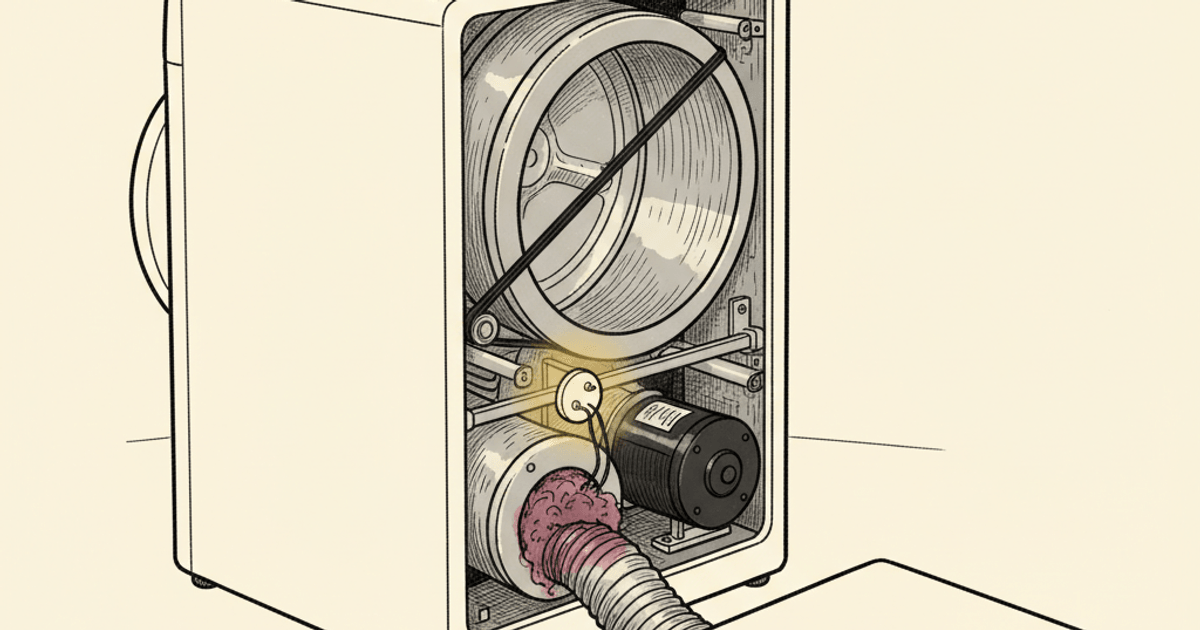
That's a first look. Point SokoJin at your dryer and Jin circles the exact part, links the cheap fix, and tells you when it's not sure. Install the free alpha →
Your dryer spins but won't heat. The fix is usually $15.
A dryer that tumbles but doesn't heat almost always has a simple electrical part failing. The most common culprit on electric dryers is a $15 thermal fuse, a safety component designed to fail when airflow gets restricted. Don't pay $300 for a service call before checking these.
Step 1: Clean the vent
Before you replace anything, check the vent. A clogged vent is what causes the thermal fuse to blow, and if you don't fix the vent first, the new fuse will blow within days. Pull the dryer out, disconnect the vent hose, and check for lint clogs both in the hose and in the wall duct.
Step 2: Test the thermal fuse
On most electric dryers, the thermal fuse is mounted on the blower housing inside the back panel. It's a small white plastic component with two wires. Remove the back panel (¼" nut driver, usually 4–6 screws), disconnect the two wires from the fuse, and test it for continuity with a multimeter.
Continuity = good. No continuity = the fuse is blown and needs replacing. A blown thermal fuse cannot be reset; it must be replaced.
Step 3: Replace the thermal fuse
New fuse, two screws, reconnect the wires. The replacement should match the temperature rating of the original (usually labeled on the fuse, e.g., "Therm Fuse 250V 15A"). Plug the dryer in, run a test cycle.
Step 4: If it's not the fuse
The next suspects, in order of likelihood:
- Heating element, also testable with a multimeter, typically $30–$50.
- High-limit thermostat, sits near the heating element, $15–$25.
- Cycling thermostat, controls regular heating, $15–$30.
Parts and tools
- Whirlpool / Maytag / Kenmore / KitchenAid / Roper dryer thermal fuse (OEM WP3392519, 196°F cutoff), for other brands (Samsung, LG, Bosch, GE) look up your model number first View on Amazon →
- AstroAI AM33D digital multimeter (the basic-but-good $20 pick) View on Amazon →
- Klein Tools 32500 11-in-1 screwdriver + ¼" nut driver (one tool for every appliance you'll ever fix) View on Amazon →
- Dryer heating element, model-specific; search "your model number heating element" instead of grabbing a generic one Find on Amazon →
Amazon links above are affiliate links. If you buy through them, SokoJin earns a small commission at no extra cost to you. Full disclosure.
Gas dryer? Read this first.
Most of the above applies to gas dryers too, except the heating element. Gas dryers have a gas valve, igniter, and flame sensor instead. The igniter ($25–$40) is the most common failure. If you're working with a gas dryer and don't have experience with gas appliances, this is one where calling a pro is reasonable, even though the part itself is cheap.
Stop and call a pro if you see this
- Any smell of gas near a gas dryer, leave the room, leave the door open, call your gas utility, not us.
- A burning electrical smell that persists with the dryer unplugged (heat retained = something melted, somewhere).
- Scorch marks around the heating-element housing, or sparks from the terminals when the dryer is on.
Want a walkthrough specific to your dryer?
Snap a photo of the model number sticker and Jin will tailor the steps.
Install the free alpha →